



Somatostatin Receptor
SSTRs; SSTR
Somatostatin receptors (SSTR1, 2A and B, 3, 4 and 5) belong to the G protein coupled receptor family. Somatostatin receptors are expressed in a variety of human tumors, including most tumors of neuroendocrine origin, breast tumors, certain brain tumors, renal cell tumors, lymphomas, and prostate cancer. Somatostatin triggers cytostatic and cytotoxic effects and has a general inhibitory effect on secretion mediated through its interaction with somatostatin receptors.
The SSTRs 1-4 display weak selectivity for somatostatin-14 binding, whereas SSTR5 is somatostatin-28-selective. Based on structural similarity and reactivity for octapeptide and hexapeptide somatostatin receptor analogs, SSTRs 2, 3 and SSTR5 belong to a similar somatostatin receptor subclass; SSTRs 1-4 react poorly with these analogs and belong to a separate subclass. All five somatostatin receptors are functionally coupled to inhibition of adenylyl cyclase via pertussis toxin-sensitive guanosine triphosphate (GTP)-binding proteins. mRNA for SSTRs 1-5 is widely expressed in brain and peripheral organs and displays an overlapping but characteristic pattern that is subtype-selective and tissue- and species-specific. All pituitary cell subsets express SSTR2 and SSTR5, with SSTR5 being more abundant. Individual pituitary cells coexpress multiple somatostatin receptor subtypes.
Somatostatin Receptor Isoform Specific Products
All Product Categories
-
Somatostatin Receptor Inhibitors
(21)
View all products
-
Somatostatin Receptor Agonists
(58)
View all products
-
Somatostatin Receptor Antagonists
(31)
View all products
-
Somatostatin Receptor Activators
(5)
View all products
-
Somatostatin Receptor Modulators
(4)
View all products
-
Somatostatin Receptor Chemicals
(2)
View all products
-
Somatostatin Receptor Control
(1)
View all products
-
Somatostatin Receptor Ligands
(5)
View all products
-
Somatostatin Receptor Related Products (157)
Related Products (157)

-
Antibodies (10)
-
Somatostatin Receptor Isoform Comparison
-
NOTA-Octreotide
 0 ImagesCat. No.: HY-P0036DCAS No.: 1427427-01-7NOTA‑Octreotide is a selective SSTR2‑targeting PET tracer. NOTA‑Octreotide binds specifically to SSTR2 and accumulates in SSTR2‑expressing tissues. NOTA‑Octreotide enables effective imaging of somatostatin receptor‑positive tumors in mice and shows high specific uptake in SSTR2‑expressing organs in healthy rats. NOTA-Octreotide can be used for PET imaging investigation of neuroendocrine tumors..
-
JR11-PEG3-DOTA-PSMA-03
 0 ImagesCat. No.: HY-P11488JR11-PEG3-DOTA-PSMA-03 (Compound 2) is an RDC-related compound containing the chelating agent DOTA (HY-W053583), the JR11 peptide (SSTR2 antagonist), and the PSMA ligand. JR11-PEG3-DOTA-PSMA-03 shows SSTR2-binding affinities and PSMA-binding affinities, with IC50 s of 94.0 nM, 81.8 nM, respectively. JR11-PEG3-DOTA-PSMA-03 can be radiolabeled with [68Ga]. [68Ga] radiolabeled JR11-PEG3-DOTA-PSMA-03 can be used in diagnostic studies of neuroendocrine differentiated prostate cancer.

-
Ac-crown-TATE
 0 ImagesCat. No.: HY-P11900Ac-crown-TATE is an actinium-labeled radioligand derived from the SSTR2 agonist crown-TATE, which targets neuroendocrine tumors with high SSTR2 expression. The [226Ac]Ac-crown-TATE form of Ac-crown-TATE possesses both SPECT-detectable γ-emission and α-radiation properties, and it inhibits tumor growth and prolongs survival. Ac-crown-TATE can be used in studies of SSTR2-positive neuroendocrine tumors, targeted α-radiation, and radionuclide imaging.

-
L-797591
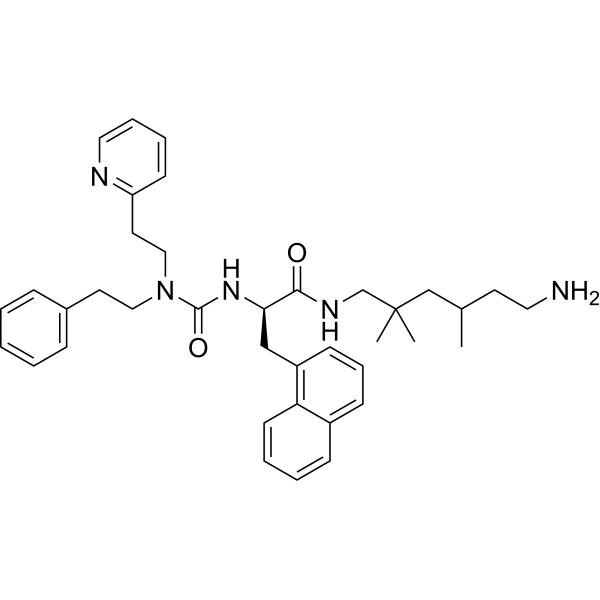 0 ImagesCat. No.: HY-125382CAS No.: 217480-24-5
-
SST1 receptor antagonist-2
 0 ImagesCat. No.: HY-177282CAS No.: 524743-70-2SST1 receptor antagonist-2 (Example 2) is a piperazine derivative and a somatostatin receptor 1 (SST1) antagonist. SST1 receptor antagonist-2 can be used in the research of psychiatric diseases, neurodegenerative diseases, tumors, as well as vascular disorders and immunological diseases.
-
L-803087 (Standard)
 0 ImagesCat. No.: HY-108497RCAS No.: 217480-26-7L-803087 (Standard) is the analytical standard of L-803087 (HY-108497). This product is intended for research and analytical applications. L-803087 is a potent and selective somatostatin sst4 receptor agonist with a Ki of 0.7 nM. L-803087 is >280-fold higher than other somatostatin receptors. L-803087 facilitates AMPA-mediated hippocampal synaptic responses in vitro and increases kainate-induced seizures in mice.
-
Somatostatin RC-102
 0 ImagesCat. No.: HY-P2167CAS No.: 99685-66-2Somatostatin RC-102 is an octapeptide analog of Somatostatin. Somatostatin RC-102 inhibits the release of growth hormone and insulin. Somatostatin RC-102 enhances the inhibition of cell migration by increasing the production or activity of LMIF, but exerts no effect on cell migration in the absence of exposure to cardiac antigens or phytohemagglutinin. Somatostatin RC-102 inhibits gastric acid secretion. Somatostatin RC-102 can be used in the research of heart diseases.
-
Octreotide-d8
 0 ImagesCat. No.: HY-P0036S2CAS No.: 1240797-41-4Synonyms: SMS 201-995-d8Octreotide-d8 (SMS 201-995-d8) is deuterium labeled Octreotide. Octreotide (SMS 201-995) is a somatostatin receptor agonist and synthetic octapeptide endogenous somatostatin analogue. Octreotide (SMS 201-995) can bind to the somatostatin receptor and mainly subtypes 2, 3, and 5, increases Gi activity, and reduces intracellular cAMP production. Octreotide (SMS 201-995) has antitumor activity, mediates apoptosis and may also be used in disease studies in acromegaly.
-
Branosotine
 0 ImagesCat. No.: HY-159825CAS No.: 2412849-26-2Branosotine (compound 1-1) is a potent agonist of somatostatin receptor (SSTR2), with the EC50 of <0.1 nM.
-
Zavolosotine
 0 ImagesCat. No.: HY-164040CAS No.: 2604416-66-0Zavolosotine (Compound 1) is an orally active agonist for somatostatin receptor type 5 (SST5) with EC50 <1 nM. Zavolosotine inhibits insulin and glucagon secretion, increases levels of glucagon in blood in rat model.
-
Mazisotine tartrate
 0 ImagesCat. No.: HY-139347ACAS No.: 2919211-45-1Synonyms: LY3556050 tartrate; CNTX-0290 tartrateMazisotine (CNTX-0290) tartrate is an orally active, non-opioid somatostatin receptor 4 (SSTR4) agonist with an EC50 of 4.7 nM. Mazisotine tartrate exerts significant analgesic effects in various nociceptive (inflammatory, osteoarthritic) and neuropathic pain models. Mazisotine tartrate can be used for pain research.
-
SSTR5 antagonist 3
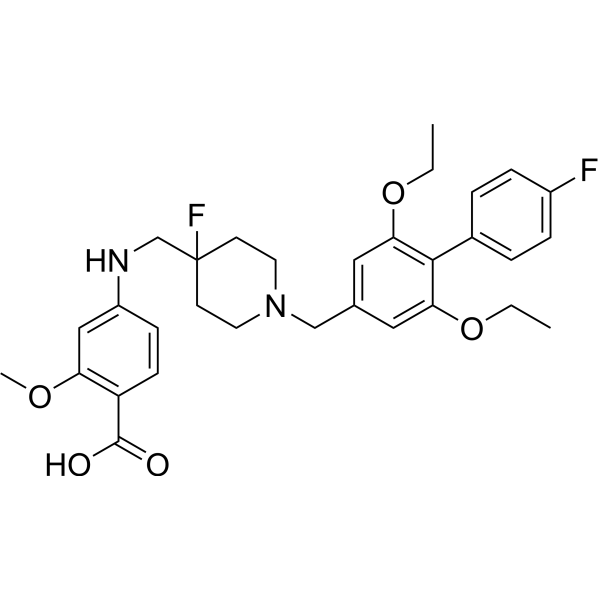 0 ImagesCat. No.: HY-157303CAS No.: 2851454-42-5SSTR5 antagonist 3 (Compound 23) is an orally active somatostatin receptor subtype 5 (SSTR5) antagonist with low hERG inhibition. SSTR5 antagonist 3 exhibits potency with IC50 values of 2.8 nM and 1.4 nM in human and mouse, respectively. SSTR5 antagonist 3 can be used for the research of anti-gallstone.
-
SSTR5 antagonist 1 (Standard)
 0 ImagesCat. No.: HY-102037RCAS No.: 1628741-91-2SSTR5 antagonist 1 (Standard) is the analytical standard of SSTR5 antagonist 1 (HY-102037). This product is intended for research and analytical applications. SSTR5 antagonist 1 (compound 25a) is a selective and orally available somatostatin receptor subtype 5 (SSTR5) antagonist with IC50s of 9.6 and 57 nM for hSSTR5 and mSSTR5, respectively.
-
J-2156 TFA (Standard)
 0 ImagesCat. No.: HY-111615ARCAS No.: 2387505-73-7J-2156 TFA (Standard) is the analytical standard of J-2156 (TFA) (HY-111615A). This product is intended for research and analytical applications. J-2156 TFA is a high potent, selective somatostatin receptor type 4 (SST4 receptor) agonist with IC50s of 0.05 nM and 0.07 nM for human and rat SST4 receptors, respectively. J-2156 TFA has anti-inflammatory activity and it is used for the relief of mechanical allodynia and mechanical hyperalgesia in the ipsilateral hindpaws in rats.
-
Octreotide-d8 TFA
 0 ImagesCat. No.: HY-P0036SSynonyms: SMS 201-995-d8 TFAOctreotide-d8 (SMS 201-995-d8) TFA is the deuterium labeled Octreotide TFA. Octreotide (SMS 201-995) is a somatostatin receptor agonist and synthetic octapeptide endogenous somatostatin analogue. Octreotide (SMS 201-995) can bind to the somatostatin receptor and mainly subtypes 2, 3, and 5, increases Gi activity, and reduces intracellular cAMP production. Octreotide (SMS 201-995) has antitumor activity, mediates apoptosis and may also be used in disease studies in acromegaly.




